The Sound of Healing: Acoustics in Healthcare
Designing for the modern healthcare environment is complex. It’s a place of advanced technology and life-saving procedures, but it’s also a space filled with vulnerability and recovery. A quiet, calm environment is not just a luxury in healthcare, but a medical necessity. Excessive noise raises blood pressure, increases heart rates, and disrupts vital sleep patterns essential for healing.
For staff, constant acoustic chaos can contribute to fatigue and communication errors which can also be detrimental to patient outcomes.
As we look at the materials that shape these environments, floors stand out as a significant factor. They cover approximately 25% of every facility and serve as a primary reflector—or absorber—of sound. High-performance seamless flooring offers an effective solution that supports both clinical safety and restorative silence.
The Impact of Noise on Recovery
Research shows that hospital noise levels often exceed international recommendations. The World Health Organization (WHO) guidelines suggest that average background noise in hospitals should not exceed 35 decibels (dB) during the day and 30 dB at night. However, busy clinical settings often register values rivaling the volume of a busy restaurant or traffic.
This "noise pollution" triggers the body’s stress response. For a patient trying to recover, the sharp clatter of a cart over tile can trigger a spike in cortisol levels. By controlling the acoustic environment, we can help lower patient stress, improve sleep quality, and create a workspace where medical teams can focus and communicate clearly.
Where Traditional Flooring Struggles
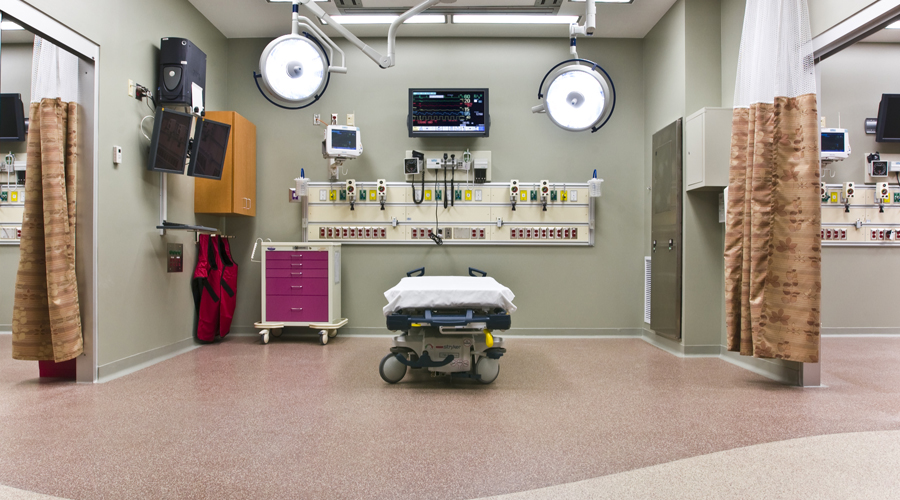
In the past, designers faced a difficult trade-off. Soft surfaces, like carpet, are excellent for acoustics but unsuitable for clinical areas due to infection control risks. Hard surfaces, like VCT or porcelain tile, are easy to clean but reflect sound waves around the room and transmit them throughout the structure creating a chaotic auditory environment.
Furthermore, traditional hard flooring often relies on bonded seams and grout lines. These interruptions in the floor surface create vibration points. When rolling loads—such as gurneys, meal carts, or medication trolleys—move across them, they generate repetitive impact noise that can travel through the structure.
Welded seams in vinyl sheet systems can degrade, and grout lines in tile can crack over time, further degrading the acoustic properties of the floor.
The Seamless Advantage: Acoustic Stability
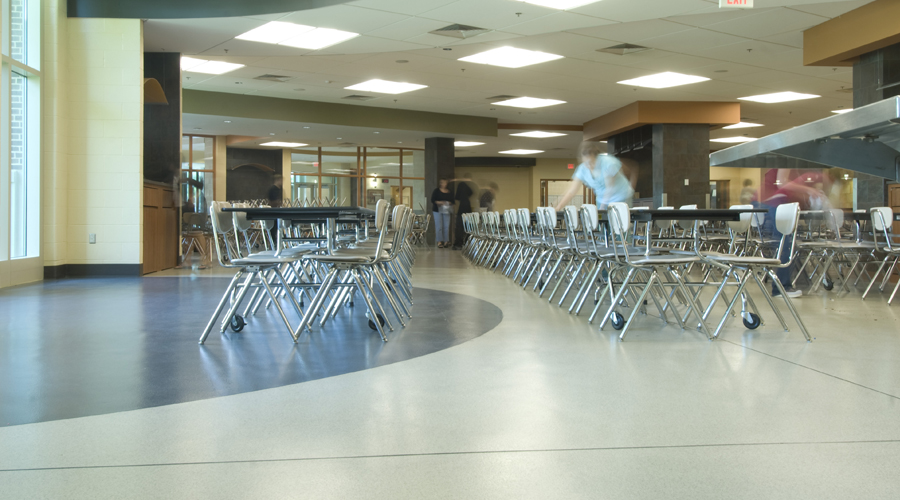
Seamless flooring systems, particularly poured-in-place resinous options, bridge the gap between hygiene and acoustics. Because these floors are highly cross-linked and fully bonded to the substrate, they create a monolithic surface that resists harsh cleaning chemicals and provides long term durability. Without the seams it eliminates the rhythmic clicking and clattering of rolling traffic, however, the benefits go deeper than just a smooth surface. High-performance resin systems offer specific acoustic properties that remain consistent over time.
These two metrics are vital:
- Impact Insulation Class (IIC): This measures how well a floor-ceiling assembly blocks structure-borne noise, such as footsteps or dropped objects.
- Sound Transmission Class (STC): This measures how well a barrier prevents airborne sound, like voices, from passing through.
Specific resin formulations, such as those used it Stonhard’s unique flex epoxy (FE) resin technology, deliver consistent performance in these areas. For example, Stonhard’s seamless FE systems can deliver an IIC of 35 (per ASTM E492) and an STC of 50 dB (per ASTM E90).
The "seamless" nature of these floors means the acoustic performance is maintained throughout its lifecycle. Stonhard floors continue to dampen sound effectively year after year, protecting the acoustic integrity of the facility long after the ribbon cutting.
Creating Quieter, Safer Spaces Together
Every healthcare project presents a unique set of challenges. You’re balancing code compliance, budget constraints, infection control, and the human need for comfort.
To us at Stonhard, flooring is part of a holistic component of the treatment environment. We’re here to partner with you to find the right system—one that stands up to heavy traffic and harsh chemicals while contributing to the quiet calm necessary for healing.
Let's design spaces that not only look exceptional but sound like healing.